Managing accounts in Content Controller
Introduction to Accounts
An account is how Content Controller distributes content. A license is a mechanism for putting limits on how content is accessed from a specific LMS or learning application. If you distribute content to multiple clients, you would set up an Account for each client. If you are using Content Controller to manage course distribution across internal systems, you would create an Account for each internal LMS.
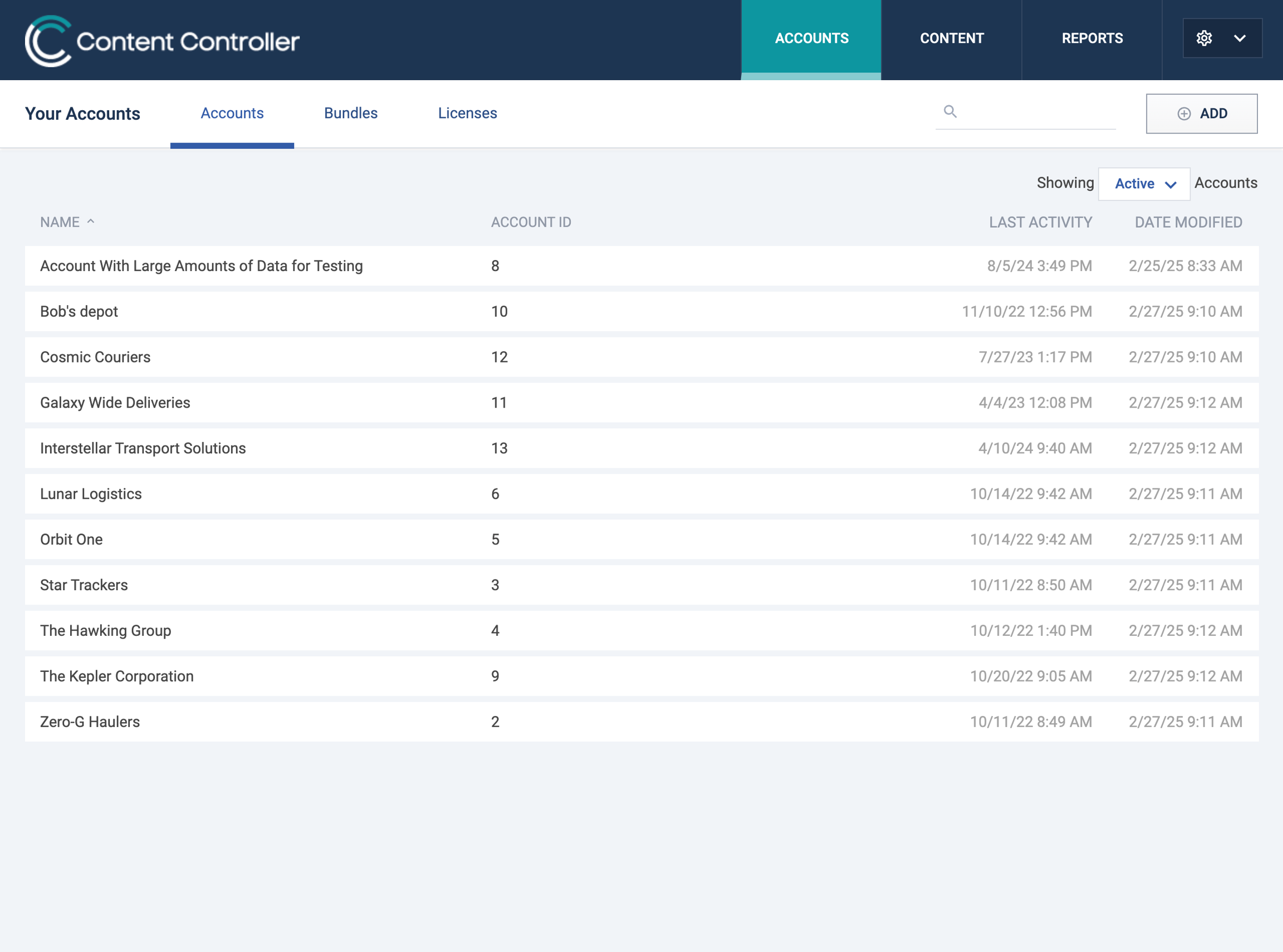
Accounts represent groups of users who access content from an LMS. Whatever exists in the CONTENT section of Content Controller, you can add to an account and then share as a small proxy package; that “dispatch” package can now be imported into an LMS and launched by learners, delivering the content straight from Content Controller. You can use licenses to control access to an account’s content.
Content Controller’s account and license management features can be accessed by clicking on the “Accounts” button on the top navigation bar.
Account-level course configuration
Set up course configuration once for an entire account.
- From ACCOUNTS, locate your account from the list and click it.
- Switch to the Advanced tab. In the left menu, find Content Configuration and click into it.
- You will see two sections: Player Launch Type and Player SCO Launch Type. In each section, configure the settings to Set By Content (Default), New Window, or Frameset. These options will affect how courses are launched.
- Optionally, use the checkbox to apply the configurations to existing account content.
- Click SUBMIT to update your settings.
- The user has the option to configure Metadata Overlays in the same section.